Kozmik AtlasCosmic Atlas

Kozmik Atlas

Gökyüzü şu an böyle duruyor. Derecesine kadar.

Kozmik Atlas bir efemeris ve doğum haritası hesaplayıcısı. Gezegen konumları cihazında, C kaynağından derlediğimiz açık kaynak bir astronomi motoruyla üretilir.

Şu an

Ay Güneş Yükselen

· varsayıldı · Ay , . Bu satır tarayıcında, az önce hesaplandı.

  • Hesap cihazda
  • Doğruluk JPL Horizons'a karşı ölçüldü
  • iPhone ve iPad · Türkçe ve İngilizce

Cosmic Atlas: Ephemeris

The sky had exact coordinates the minute you were born.

Eleven bodies, both lunar nodes, your houses, your horizon. The positions are computed on your device by an open source astronomy engine that we compile from its C source. That engine is measured against NASA JPL Horizons before it ships, and the measurements are further down this page.

Right now

Moon Sun Rising

· assumed for · Moon , lit. This line was computed in your browser, a moment ago.

  • Computed on device
  • Engine measured against NASA JPL Horizons
  • iPhone and iPad · English and Turkish

Bu sayfa şehri saat diliminden türetiyor, konum izni istemeden; hangi şehri varsaydığını da yukarıda yazıyor.

Aşağı kaydır

The city above comes from your browser time zone rather than a location request, and the page tells you which one it assumed.

Keep going

Motor

Yukarıdaki gökyüzünü senin tarayıcın hesapladı.

Bu sayfadaki gökyüzü, uygulamanın kullandığı motorun aynısıyla üretiliyor: astronomy-engine v2.1.19, Don Cross'un MIT lisanslı açık kaynak kütüphanesi. Uygulamada bu kütüphanenin C kaynağı repoya alınıp uygulamanın içine derleniyor ve gezegen konumları cihazında koşuyor. Burada, sayfada, aynı sürümün npm paketi değiştirilmeden yükleniyor ve hesap tarayıcında yapılıyor.

Sayfa gökyüzü için hiçbir sunucuya soru sormuyor. Sekmeyi kapattığında hesap da bitiyor. Bu sayfanın kendi dış isteği tek kalemde toplanıyor: yazı tiplerini Google Fonts sunuyor (fonts.googleapis.com ve fonts.gstatic.com), gökyüzü hesabı tarayıcında kalıyor.

Motor
astronomy-engine
Sürüm
v2.1.19
Lisans
MIT · Don Cross
Uygulamada
C kaynağından derlenmiş hâli, cihazda
Bu sayfada
Aynı sürümün npm paketi, tarayıcında
Sahnede
10 gök cismi · 50 parlak yıldız

Cihazda C kodunda koşanlar Gezegen konumları, yükselen, MC, ev sınırları, transit tespiti, yıllık tepe noktaları, asteroit toplu hesabı ve tutulma taraması. Açılar bu listede değil: native yolları kapalı gönderiliyor, o yüzden JavaScript tarafında hesaplanıyorlar. Hangisinin nerede koştuğunu yuvarlamak yerine yazmayı tercih ediyoruz.

Sayfadaki çizim iki yerde sadeleşiyor Işık kırılması uygulanmıyor, yani ufuk geometrik ufuk. Gezegenlerde aberasyon düzeltmesi kapalı, uygulamayla aynı tercih. Fark yaklaşık 20 yay saniyesi.

Doğruluk

Sapmayı ölçtük, otuz satırın hepsi aşağıda.

Motorun ürettiği jeosentrik ekliptik boylamlar NASA JPL Horizons'a karşı sınandı. 10 gök cismi, 3 ayrı epoch, toplam 30 bağımsız ölçüm.

En büyük sapma

0,0078°

28 yay saniyesi. Neptün, 1 Ocak 2000. Otuz ölçümün en kötüsü bu.

30

Bağımsız ölçüm

10 gök cismi × 3 epoch

0,0040°

Ortalama sapma

14,4 yay saniyesi

0,02°

Testin doğruladığı tavan

Ölçülenin yaklaşık 2,5 katı

0

0,008 dereceyi aşan ölçüm

Otuzunun hiçbiri

Referans veri 15 Temmuz 2026'da JPL Horizons API'sinden çekildi ve parametreler kayıtlı: ObsEcLon, yani jeosentrik ve görünür boylam, ışık zamanı ile aberasyon dahil; gözlemci merkezi 500@399. Epoch'lar 1 Ocak 2000, 15 Temmuz 2026 ve 1 Ocak 2030, yani geçmiş, şimdi ve gelecek ayrı ayrı sınanıyor.

Bu sapma ne kadar küçük? Astrolojide açı orb'ları tipik olarak 1 ile 8 derece arasındadır. En dar orb bile 28 yay saniyesinin yaklaşık 128 katı; ölçülen sapma, yorumun kullandığı toleransın epeyce altında kalıyor.

Üç dürüst çekince Bu sapmanın büyük kısmı bir hata değil, bilinçli bir tercih. Gezegenlerde aberasyon düzeltmesini kapalı tutuyoruz; Horizons ise onu açık raporluyor. Aynı otuz ölçümü aberasyon açıkken tekrarladığımızda ortalama sapma 0,0040 dereceden 0,00086 dereceye, en büyük sapma 0,0078 dereceden 0,0033 dereceye iniyor. Yani sapmanın yaklaşık beşte dördü bu tek tercihten geliyor.

Bu koşum JavaScript yolunda yapıldı. Uygulamada gezegen konumları cihazda C kodunda koşuyor; iki yolun bire bir aynı çıktıyı verdiği ayrıca ölçülmedi.

Asteroitler gezegenler kadar sıkı değil, o yüzden ikisini ayrı yazıyoruz. Swiss Ephemeris'e karşı 28 referans asteroidi 0,73 derecenin içinde kalıyor, tek istisna 1,84 derecede. 158 asteroidin tamamı aynı epoch'ta JPL Horizons'a karşı ölçüldüğünde 152'si 1,5 derecenin içinde, en kötüsü yüksek dışmerkezli bir yörüngede 3,56 derece. İki cisim yaklaşımının dürüst sınırı bu; asteroit derken gezegen dememizin sebebi de bu.

Otuz ölçümün tamamı
Motor ve NASA JPL Horizons boylamlarının karşılaştırması, derece cinsinden.
EpochCisimMotorHorizonsSapma
2000-01-01T12:00ZGüneş280,3745280,36890920,0056
2000-01-01T12:00ZAy223,3239223,3237860,0001
2000-01-01T12:00ZMerkür271,8946271,88926990,0054
2000-01-01T12:00ZVenüs241,5697241,56577940,0040
2000-01-01T12:00ZMars327,9678327,96329210,0045
2000-01-01T12:00ZJüpiter25,252725,25306850,0004
2000-01-01T12:00ZSatürn40,393240,39563660,0024
2000-01-01T12:00ZUranüs314,8109314,8091680,0017
2000-01-01T12:00ZNeptün303,2008303,19300070,0078
2000-01-01T12:00ZPlüton251,4599251,45476440,0051
2026-07-15T00:00ZGüneş112,5592112,55400380,0052
2026-07-15T00:00ZAy120,8769120,87617320,0008
2026-07-15T00:00ZMerkür109,4870109,48152860,0055
2026-07-15T00:00ZVenüs155,8462155,84247610,0037
2026-07-15T00:00ZMars71,414071,4100640,0040
2026-07-15T00:00ZJüpiter123,2089123,20402410,0049
2026-07-15T00:00ZSatürn14,627614,63097540,0034
2026-07-15T00:00ZUranüs64,365964,36243570,0035
2026-07-15T00:00ZNeptün4,40454,40297270,0015
2026-07-15T00:00ZPlüton304,5651304,57104850,0059
2030-01-01T00:00ZGüneş280,6083280,60233460,0060
2030-01-01T00:00ZAy238,4229238,42155770,0013
2030-01-01T00:00ZMerkür279,4622279,45694140,0053
2030-01-01T00:00ZVenüs289,5541289,54706810,0071
2030-01-01T00:00ZMars314,7065314,70132210,0052
2030-01-01T00:00ZJüpiter230,5777230,57450310,0032
2030-01-01T00:00ZSatürn48,393648,39776710,0041
2030-01-01T00:00ZUranüs75,552075,55763470,0057
2030-01-01T00:00ZNeptün8,38068,37813820,0024
2030-01-01T00:00ZPlüton309,1695309,16483840,0046

Ekliptik boylam, derece. Motor değerleri JavaScript yolundan, 8 Eylül 2026'da alındı. Horizons değerleri 15 Temmuz 2026'da çekildi: jeosentrik görünür boylam, gözlemci yerin merkezinde.

Dokuz doğrulama kapısı

Horizons kapısı tek başına değil. Uygulamanın hesaplama künyesinde dokuz kapı adıyla listeleniyor: sekizi bir dış referansa bakar, biri determinizm ve zaman duyarlılığı testidir.

  • horizons-accuracyGezegen boylamları, NASA JPL Horizons.
  • keplerian-reference28 asteroit boylamı, pyswisseph üzerinden Swiss Ephemeris.
  • chiron-accuracyChiron boylamı, dört bağımsız referans.
  • mirayyy-natal-validationTam natal harita, Astrodienst raporu; tolerans 0,15 derece, Chiron için 1 derece.
  • mirayyy-transits-validationBelirli bir günün transitleri, Astrodienst raporu, 0,15 derece.
  • mirayyy-asteroids-validationAsteroit yerleşimleri, Astrodienst raporu.
  • moon-phase-accuracyAy fazları; çapa noktaları gerçek tutulmalar, yani tanımı gereği kesin syzygy.
  • astronomical-referencesYükselen, MC ve Güneş; bilinen IAU ve NASA noktaları, 0,5 derece.
  • ascendant-accuracyBu kapı bir dış referans yerine kararlılığı ölçer: aynı girdi aynı sonucu veriyor mu, bir dakikalık kayma yükseleni değiştiriyor mu.

Dokuzu da 8 Eylül 2026'da, 1.24.0 sürümüne karşı koşuldu: 9 suite, 305 test, hepsi geçti.

Katmanlar

Ne hesaplıyor

Her satırın altında gerçek bir hesap var. Hangisi olduğunu da yazıyoruz.

Doğum haritasının kendisi

Güneş'ten Plüton'a on gezegen ve Chiron, yani on bir gök cismi; yanlarında Ay Düğümleri'nin ikisi ve Kara Ay Lilith'in hem ortalama hem gerçek hâli. Açılar kendi orb'larını taşır: kavuşum, kare, üçgen ve karşıt 8 derece, sekstil 6 derece, quincunx 3 derece.

11 gök cismi · 12 burç · 6 açı türü

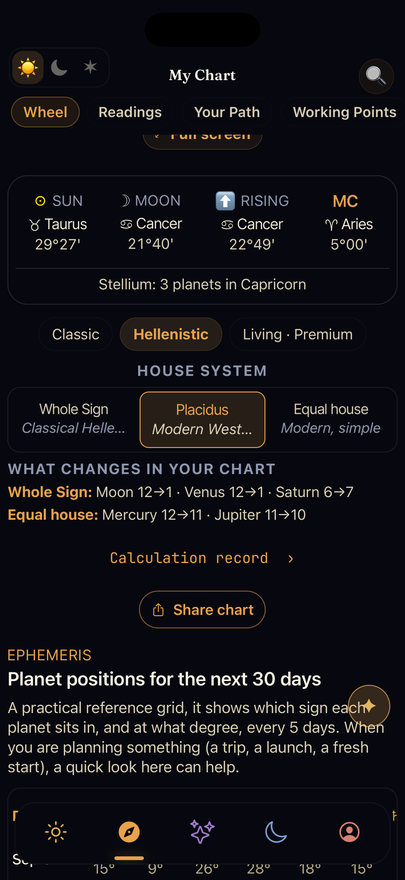
Ev sistemleri

Whole Sign, Placidus ve Eşit arasında geçiş yapabilir, geçmeden önce hangi gezegenin ev değiştireceğini görebilirsin. Placidus yarı yay üçlemesiyle iteratif çözülür; kutup enlemlerinde, 66 derecenin ötesinde geometrisi tanımsız kaldığı için Porphyry'ye düşer. Bu sınırın nerede olduğunu uygulamanın hesaplama künyesi yazıyor.

3 sistem · iteratif çözüm

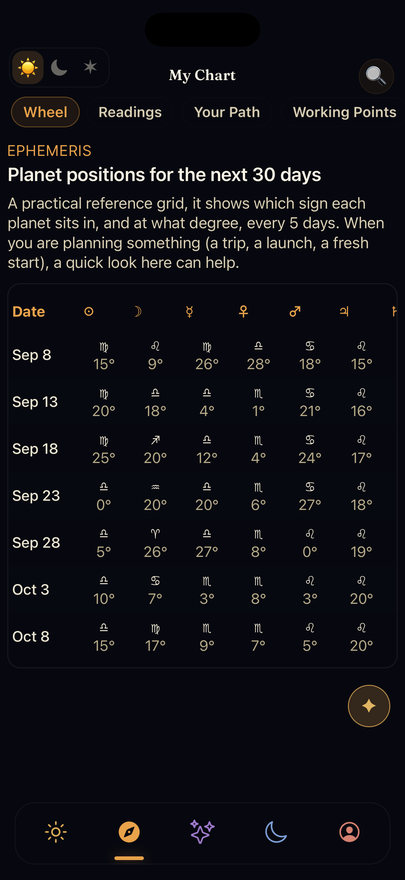
Efemeris cetveli

Önündeki otuz günün ızgarası: hangi gök cismi hangi burçta, kaçıncı derecede. Beş günde bir satır, tamamı cihazında hesaplanır.

7 gök cismi · 5 günlük adım · 30 günlük pencere

Helenistik zaman efendileri

Yıllık ve aylık profeksiyon, yılın efendisinin natal burcu ve eviyle birlikte gelir. Zodyakal salınım Ruh Lotu'ndan başlar ve burç başına Valens periyodunu kullanır; almuten figuris beş asalet ağırlığını sayar, yöneticilik 5, yücelme 4, üçlülük 3, sınır 2 ve dekan 1; gündüz/gece doğumu ayrımı (sect) ise haritanın kendisinden türetilir.

5 asalet ağırlığı · Ruh Lotu'ndan L1 dönemleri

Asalet, gündüz/gece ve lotlar

Esasi asalet tam hâliyle: yöneticilik, yücelme, gündüz ve gece için ayrılmış Dorothean üçlüleri, Mısır sınırları ve Kildani dekanlar. Tabloların hepsi kodda açıkça yazılı. Şans, Ruh ve Eros lotları tek bir sect bayrağını paylaşır, yani formüller sessizce ayrışamaz. Şans Noktası için uygulama, Güneş'in doğduğun anda ufkunun gerçekten üstünde olup olmadığını hesaplar.

5 asalet kaynağı · Şans Noktası'nda gerçek Güneş yüksekliği

Zaman ve yer

Doğum saatin, doğum yerinin IANA saat dilimi üzerinden UTC'ye çevrilir; o tarihte geçerli olan yaz saati kuralları, sonradan kaldırılmış olanlar dahil, böylece uygulanır. Saat dilimi uygulamanın içinde taşınan çevrimdışı bir poligon tablosundan gelir ve uçak modunda da çözülür. IANA dilimi bulunamadığında sayısal ofsete düşer; o yolda tarihsel yaz saati kuralları uygulanamaz.

Çevrimdışı saat dilimi · yaklaşık 72 KB veri

Sabit yıldızlar

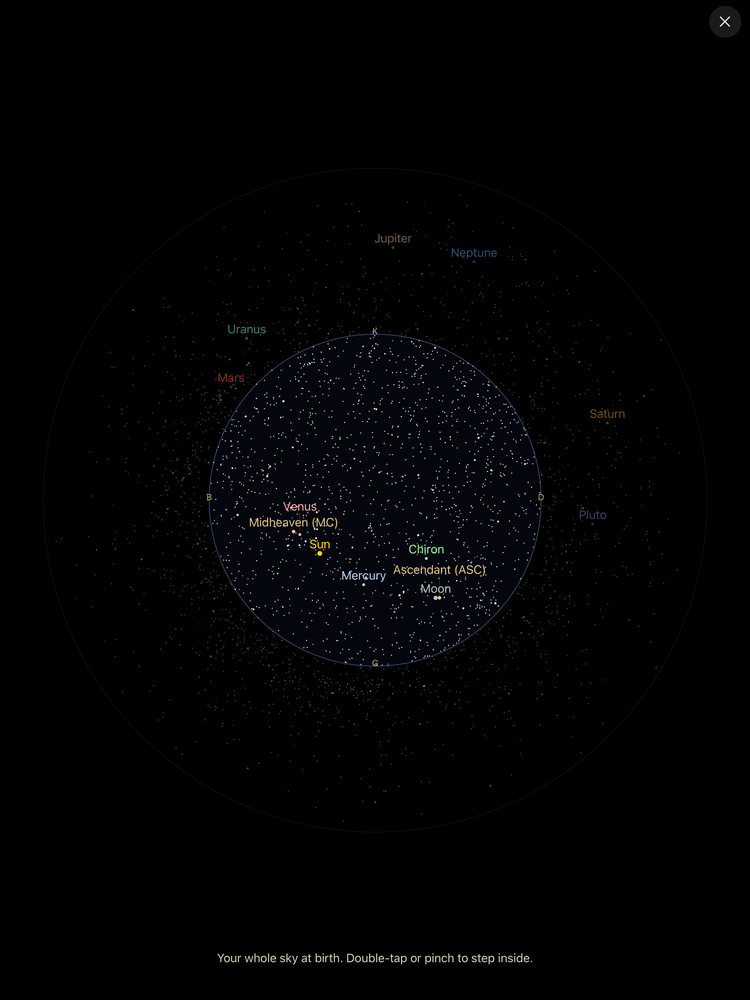
52 yıldız, J2000 katalog koordinatlarından tarihin ekliptiğine her seferinde yeniden hesaplanır. Presesyon böylece kendiliğinden gelir; hazır bir boylam listesi okunmaz.

Doğum anının üç boyutlu gökküresinde ayrıca Yale Bright Star Catalogue'dan görsel kadir 5,5'e kadar 2887 yıldız çizilir. Bu katman bakılmak içindir ve astrolojik bir iddia taşımaz.

52 yıldız · 4'ü kraliyet yıldızı · kürede 2887 ışık noktası

Horary, soru astrolojisi

Sorunun sorulduğu anın haritası kurulur ve yargıdan önce dört klasik uyarı kontrol edilir: yükselen 0-3 derece, yükselen 27-30 derece, birinci ya da yedinci evde Satürn, Ay boşlukta. Boşluk taraması efemerisi 15 dakikalık adımlarla gezer, hazır bir tablodan okumaz. Sonra ışığın aktarımı, ışığın toplanması, yasaklama ve karşılıklı kabul aranır.

4 klasik uyarı · yargıdan önce

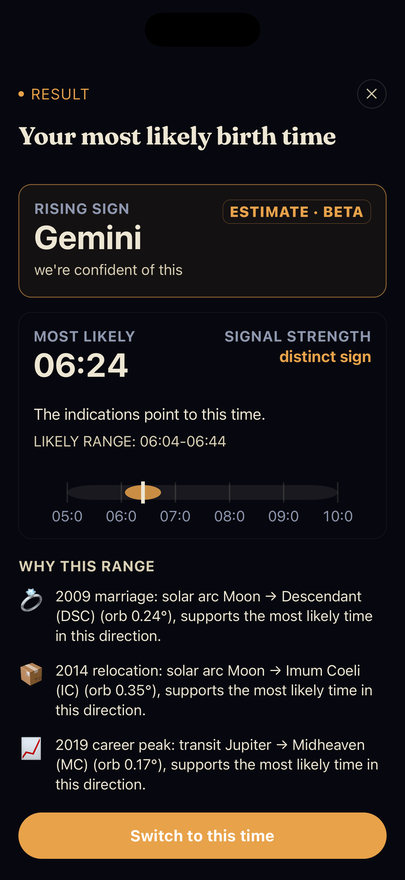
Doğum saati rektifikasyonu

Saatin belirsizse, yaşadığın olaylara beş bağımsız zaman tekniği oy verir: birincil yönelim, güneş arkı, ikincil ilerletme, transit açı ve profeksiyon. Oylar farklı ağırlıklarla tek bir güven eğrisinde kesişir ve sana bir saat aralığı önerilir.

5 teknik · tek güven eğrisi · uygulamada beta olarak işaretli

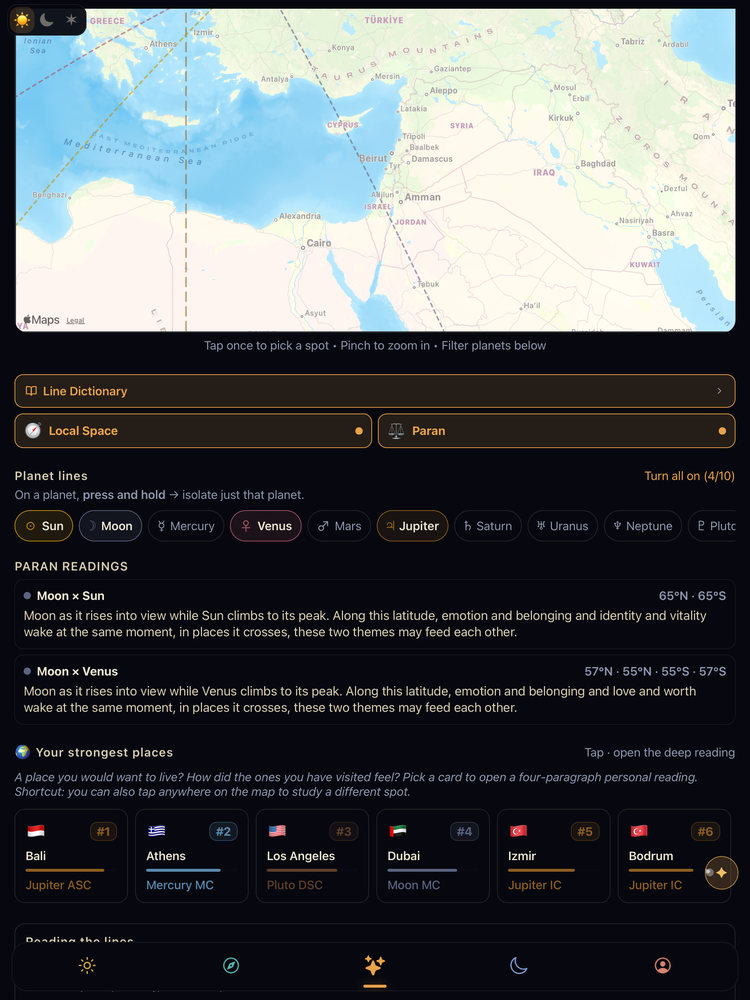
Astrokartografi

Dört klasik çizgi, yani MC, IC, ASC ve DSC, haritanın üstünde durur; yanına on gezegen için yerel uzay çizgileri ve paran enlemleri eklenir. Paran kapalı formda çözülür ve kutup bölgeleri elenir.

4 çizgi türü · 10 gezegen · paran enlemleri

Natal haritanın ötesi

Güneş ve Ay dönüşleri, bulunduğun şehre taşınabilir: gezegen konumları yerinde kalır, açılar ve ev yerleşimleri değişir. Sinastri ağırlıklı bir açı skoru ve iki yönlü okunan ev yansımalarıyla gelir. Kompozit iki yoldan kurulur, orta nokta ve Davison; Davison hem zamanın hem yerin orta noktası için gerçek bir harita hesaplar. İkincil ilerletmeler sekiz fazlı ilerletilmiş Ay döngüsüyle gelir, tutulmalar da seçtiğin ev sistemine göre kendi evine oturur.

8 ilerletilmiş Ay fazı · dönüş, sinastri, kompozit

Asteroitler

Numaralandırılmış 159 asteroit, sekiz kategoride: tanrıça, aşk, şifa, karma, kentaur, TNO, güç, zihin. 158'i JPL yörünge elemanı taşır ve konumlar Kepler denklemiyle çözülür, yani ağ olmadığında da hesap cihazda sürer.

159 asteroit · 8 kategori

Sabian sembolleri

Zodyağın 360 derecesinin tamamı, senin gerçek derecenden. Ham imajların Türkçesi 360/360 uygulamanın içinde gömülü; kaynak 1925 tarihli Marc Edmund Jones ve Elsie Wheeler çalışması, ABD'de kamu malı.

360/360 · Türkçesi uygulamanın içinde

Mundane haritalar

203 ülke haritası ve dört Güneş girişi, yani 0, 90, 180 ve 270 derece. Bu haritaların 60'ında kuruluş saati biliniyor; kalan 143'ünde saat bilinmediği için uygulama ev iddiası yapmaz.

203 harita · 60'ında saat biliniyor

Finansal astroloji

Para tarafı iki katmandan okunur. Herkese ortak olan: dört yavaş gezegen döngüsü, Boğa ile Akrep eksenindeki tutulmalar, Merkür ve Venüs'ün geri hareket pencereleri, Jüpiter ile Satürn'ün burç girişleri. Sana özel olan: yıllık profeksiyon, 2, 8 ve 11. evlere düşen tutulmalar, Jüpiter ile Satürn'ün ev yöneticilerine ve Talih Noktası'na transitleri. Tarihler efemeristen ölçülür, tabloya yazılmaz. Piyasa tahmini yoktur; bu bir yatırım tavsiyesi değil, kendi parasal alışkanlığına bakman için zamanlama bağlamıdır.

4 yavaş döngü · 2, 8 ve 11. evler

Kendi hesabını gösteren bir ekran

Bütün bunlar uygulamanın içinde de duruyor: hesaplama künyesi ekranı motoru ve sürümünü, doğruluk kapısını kaynağıyla, üç ev sistemini, katalog boyutlarını, teknik listesini, ağ sınırını ve canlı efemeris cetvelini tek sayfada gösterir. Oradaki katalog sayıları elle yazılmaz, açılışta uygulamanın içinden okunur; bu yüzden uygulamadan ayrışamazlar. Native köprü yanıt vermezse motor satırı varsayım yapmaz, "JS" yazar.

Ne kadarını okumak istediğin

Üç yorum derinliği var: Sade, Meraklı ve Derin. Derin olan teknik olanıdır, derece ve orb değerleriyle birlikte gelir. Kurulumda bir kez seçersin, sonra fikrini değiştirebilirsin.

Ekranlar

Uygulamanın içi

8 Eylül 2026'da, 1.24.0 sürümünden alınmış ekran görüntüleri. Her biri çalışan uygulamadan, maket değil. Kareler uygulamanın İngilizce arayüzünden alındı; aynı ekranlar Türkçede de var.

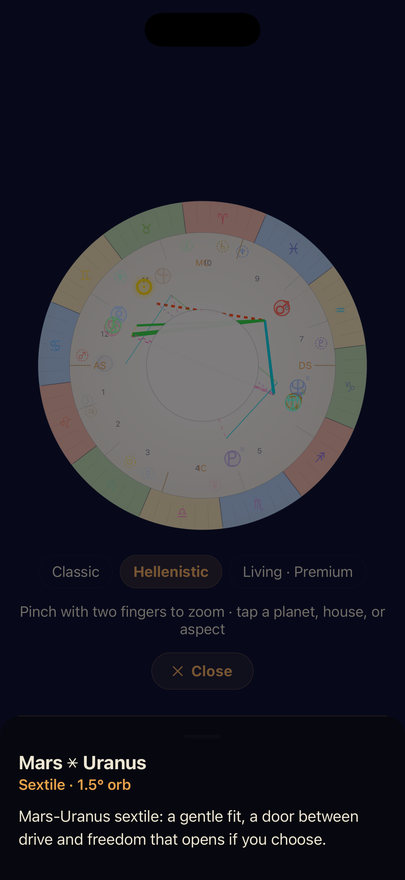
Doğum haritası çarkının üstünde açılmış bir açı kartı: Mars sekstil Uranüs, 1,5 derece orb.
Çarkta bir açıya dokunuş. Mars sekstil Uranüs, 1,5 derece orb.
Otuz günlük efemeris ızgarası: sol sütunda beş günlük tarihler, yanında yedi gök cisminin burç glifi ve derecesi.
Otuz günlük efemeris cetveli. Yedi gök cismi, beş günde bir, burç ve derece.
Rektifikasyon sonucu: en olası doğum saati 06:24, olası aralık 06:04 ile 06:44, altında aralığı destekleyen üç olay ve orb değerleri.
Rektifikasyon sonucu. En olası saat, olası aralık ve aralığı hangi olayın hangi orb'la desteklediği.
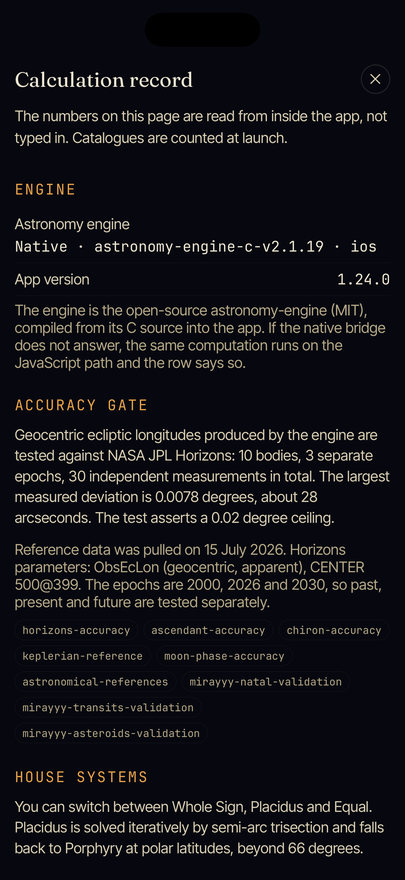
Hesaplama künyesi ekranı: motor satırı, doğruluk kapısının kaynağı ve dokuz test adının listesi.
Hesaplama künyesi. Motor sürümü, doğruluk kapısı ve dokuz test adı.
Ev sistemi seçici: Whole Sign, Placidus ve Eşit; altında hangi gezegenin hangi eve taşınacağını gösteren liste.
Ev sistemi geçişi. Whole Sign ve Eşit'e geçilse hangi gezegen hangi eve taşınır.
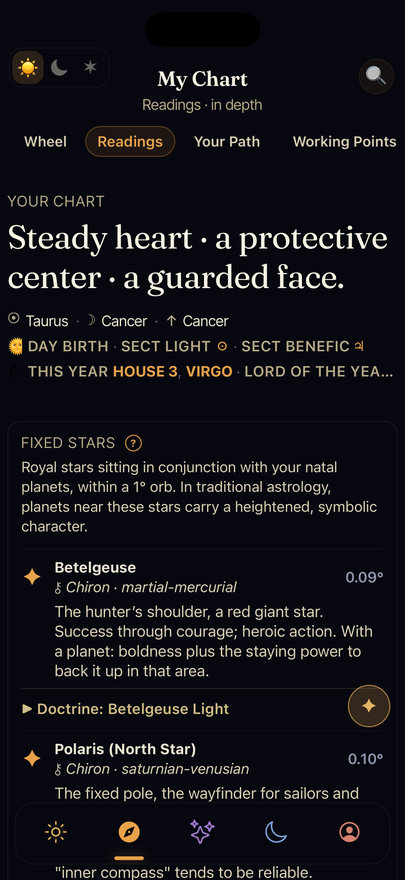
Sabit yıldız temasları listesi: Betelgeuse, Chiron'a 0,09 derece; Polaris 0,10 derece.
Sabit yıldız temasları. Betelgeuse, Chiron'a 0,09 derece.
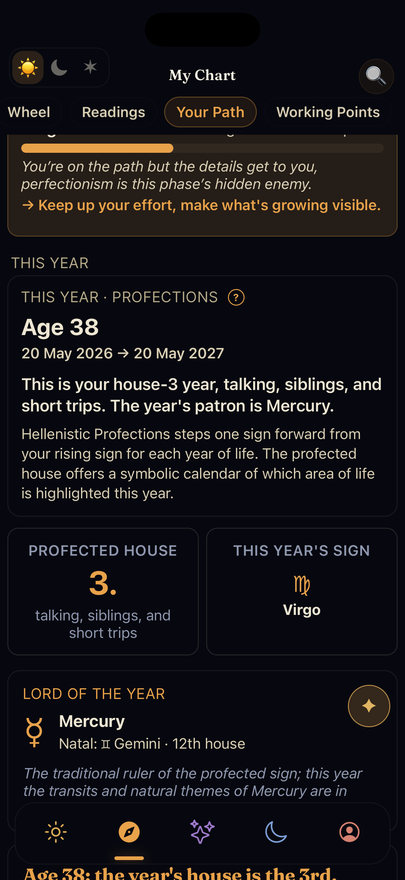
Yıllık profeksiyon kartı: 38 yaş, profekte ev 3, burcu Başak, Yılın Efendisi Merkür ve natal yeri İkizler 12. ev.
Yıllık profeksiyon. Yaşın evi, burcu ve Yılın Efendisi'nin natal yeri.
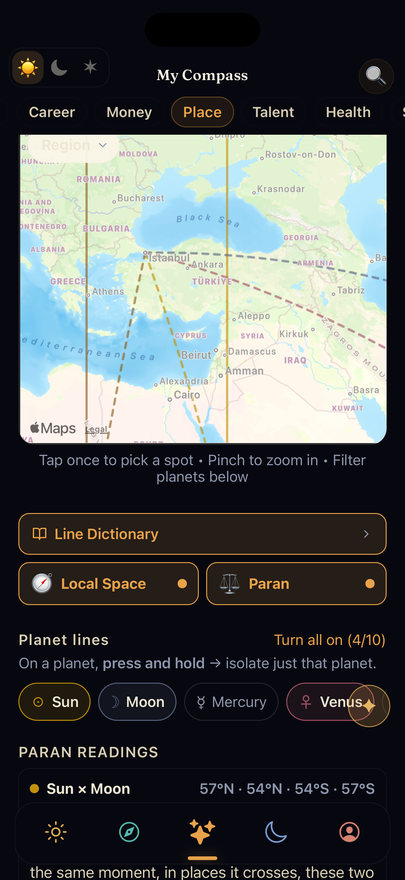
Astrokartografi haritası: Akdeniz üstünde gezegen çizgileri, altında Yerel Uzay ve Paran anahtarları ve paran enlemi okumaları.
Astrokartografi haritası. Gezegen çizgileri, yerel uzay ve paran enlemleri bir arada.
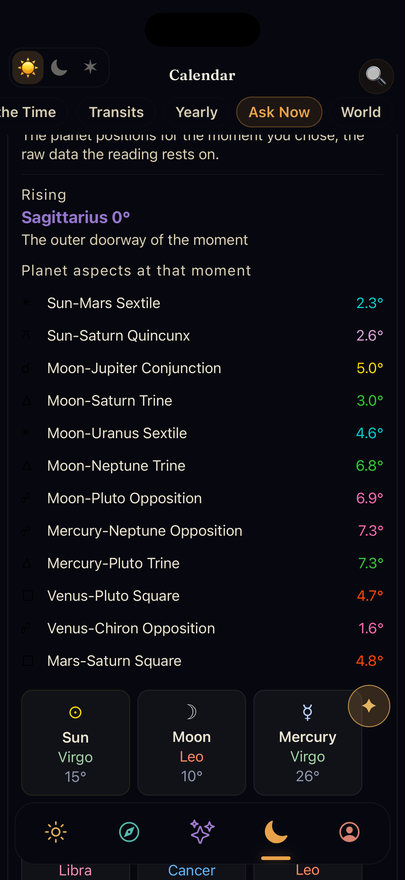
Soru anının ham verisi: yükselen Yay 0 derece, altında o anki gezegen açıları ve her birinin orb değeri.
Soru anının ham verisi. Yükselen derecesi ve o anki açılar, orb değerleriyle.
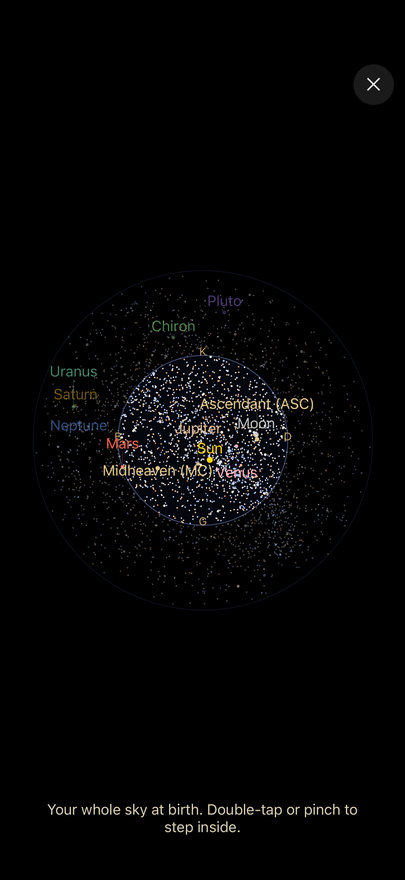
Doğum anının gökküresi: yıldız alanının üstünde Yükselen, MC ve gezegen adları etiketlenmiş.
Doğum anının gökküresi. Gezegenler, yükselen ve MC yıldız alanının üstünde.

Yana kaydır, ya da klavyeyle ok tuşlarını kullan.

Aynı uygulama, iPad'de

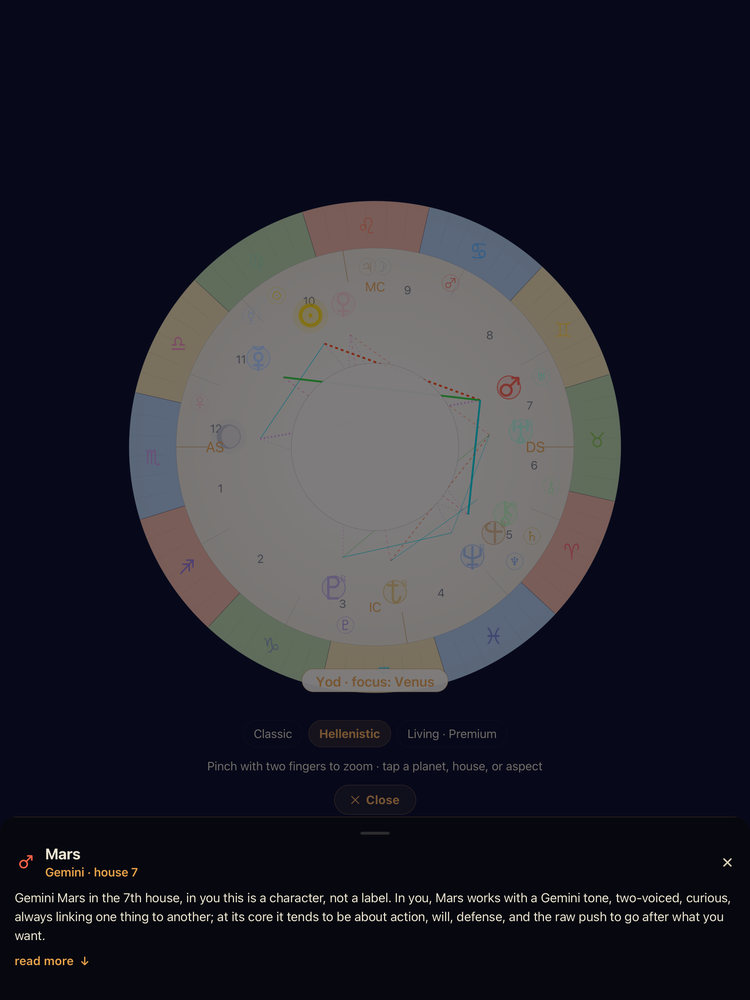
iPad'de doğum haritası çarkı, altında açılmış gezegen kartı: Mars, İkizler, 7. ev.
Çarkta bir gezegene dokunuş. İkizler Mars, yedinci ev.
iPad'de efemeris cetveli: geniş ekranda yedi gök cisminin sütunları ve beş günlük adımlarla yedi tarih satırı.
Geniş ekranda efemeris. Yedi sütun, yedi satır, beş günlük adım.
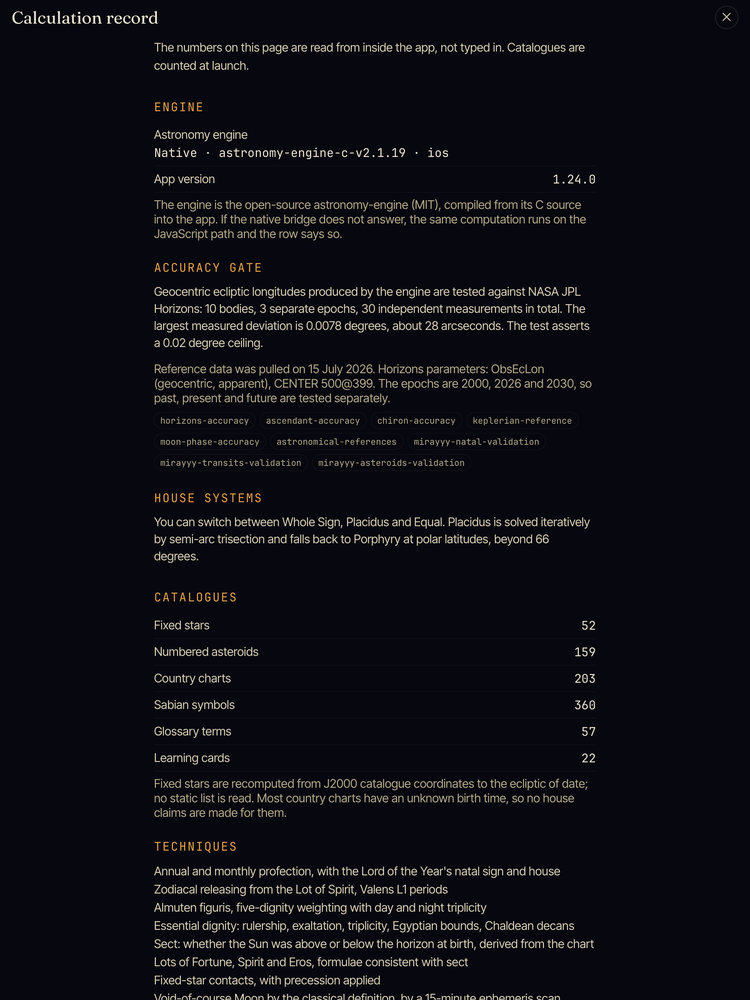
Hesaplama künyesinin katalog bölümü: sabit yıldız 52, asteroit 159, ülke haritası 203, Sabian sembolü 360, sözlük 57, öğrenme kartı 22.
Künyenin katalog bölümü. 52 sabit yıldız, 159 asteroit, 203 ülke haritası, 360 Sabian sembolü, 57 sözlük terimi, 22 öğrenme kartı.
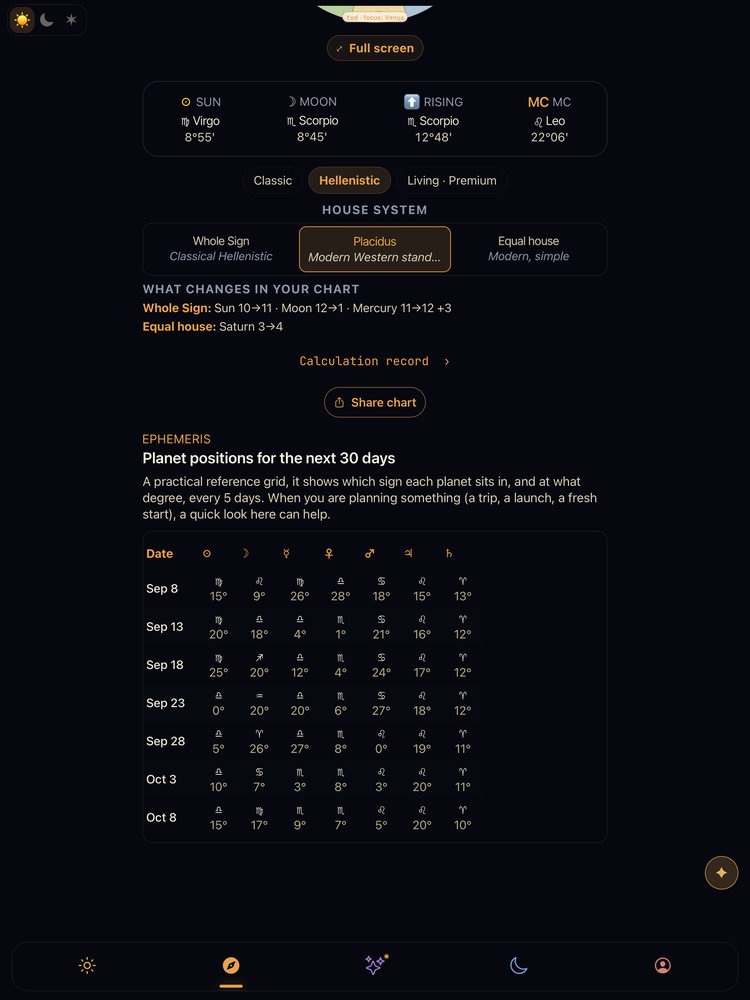
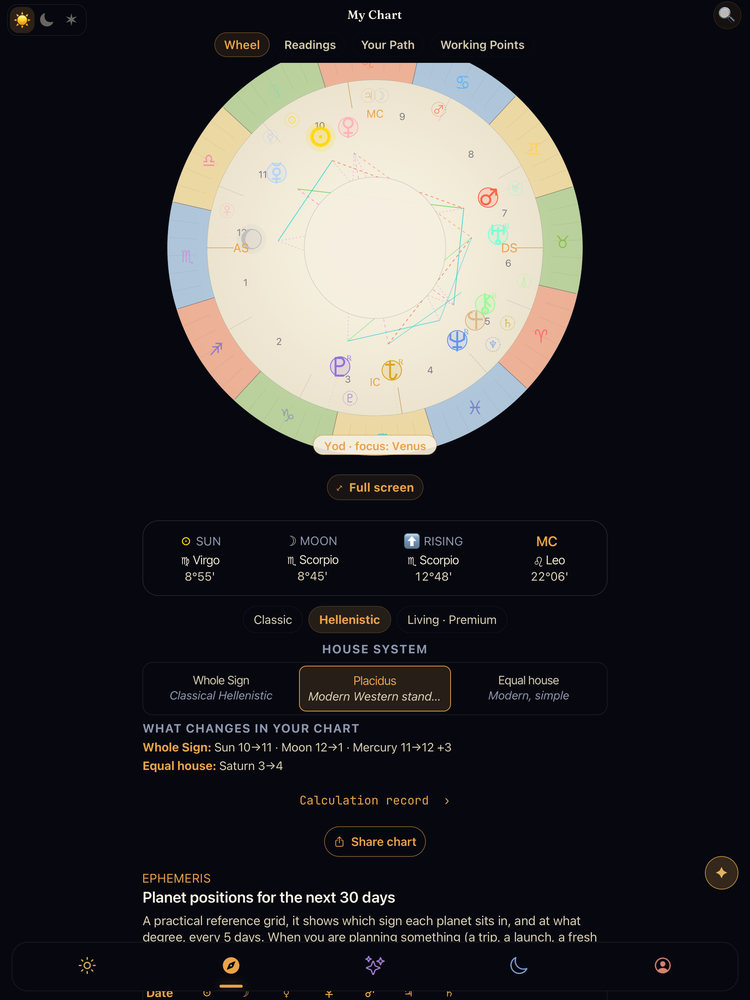
iPad'de çark ve altında ev sistemi seçimi: yükselen Akrep 12 derece 48 dakika, Placidus seçili.
Çark ve ev sistemi yan yana. Akrep yükselen, Placidus.
iPad'de astrokartografi: harita, paran enlemi okumaları ve en güçlü yerler kartları.
Paran okumaları ve en güçlü yerler. Haritanın hemen altında, sıralanmış hâlde.
iPad'de tam ekran gökküresi: doğum anının donmuş göğü, yıldız alanı ve ekliptik çemberi.
Gökküresi tam ekranda. Doğum anının donmuş göğü.

Yana kaydır, ya da klavyeyle ok tuşlarını kullan.

Gizlilik

Neler cihazda kalıyor, neler ağa gidiyor

Sınırı kodun kendisi çiziyor. Astroloji ve yer katmanındaki ağ çağrılarını tek tek sayabiliyoruz: beş uç nokta, üçü kullanımda. Hesap, senkron, satın alma ve hata kaydı ayrı yollardan gider; onları da aşağıda yazıyoruz.

Cihazda koşan hesaplar

Aşağıdakilerin her biri cihazda koşar, uçak modunda da çalışır.

  • gezegen konumları
  • yükselen ve MC
  • ev sınırları, üç sistem de
  • açılar ve orb'lar
  • sabit yıldızlar
  • lotlar ve profeksiyon
  • almuten ve esasi asalet
  • gündüz/gece ayrımı (sect)
  • zodyakal salınım
  • Ay boşlukta taraması
  • tutulma taraması
  • astrokartografi çizgilerinin ve paranların hesabı
  • ilerletmeler ve dönüşler
  • sinastri, kompozit ve Davison
  • horary
  • doğum saati rektifikasyonu
  • saat dilimi çözümü

Tek istisna, astrokartografide çizgilerin üstüne oturduğu harita: karoları Apple Maps çizer ve o katman ağ ister. Çizgilerin ve paran enlemlerinin hesabı istemez.

Astroloji ve yer katmanında ağa giden çağrılar

  1. Şehir arama, OpenStreetMap Nominatim üzerinden. Ulaşılamazsa 81 Türkiye ili ve gömülü şehir listesi devreye girer, kurulum kilitlenmez.
  2. Yüksek hassasiyetli asteroit konumu, JPL Horizons üzerinden. Ulaşılamazsa cihaz içi Kepler hesabı sürer.
  3. Sabian sembollerinin İngilizce nesir metni. Ulaşılamazsa uygulamaya gömülü 360 sembollük metin devreye girer; 360 Türkçe çeviri zaten gömülü.
  4. Kalan iki uç nokta bir ortam değişkenine bağlı ve o değişken tanımlı olmadığı için hiç çağrılmıyor.

Hesap ve senkron

Uygulamayı hesap açmadan kullanabilirsin; kurulumdaki hesap daveti kapatılabilir ve hesap yalnız satın alma anında gerekir. Giriş parolasız, e-posta ile gelen tek kullanımlık kodla yapılır. Yerel kayıt cihazdaki SQLite tabanlı depoda tutulur.

Dürüst olalım Hesap açar ve senkrona açıkça rıza verirsen doğum bilgin ve haritan bizim sunucumuza yazılır. Rıza kaydı karar tarihiyle ayrı bir tabloda tutulur; senkronu kapatabilir, hesabını ve tüm verini uygulama içinden silebilirsin.

Ayrı yollardan gidenler

Yukarıdaki beş uç nokta astroloji ve yer katmanını kapsıyor. Uygulamanın geri kalanında ağ şuralarda da var.

  • Hesap ve senkron. Girişteki tek kullanımlık kod ve, açık rıza verirsen, haritanın senkronu. İkisi de kendi Supabase sunucumuza gider; ayrıntısı yukarıdaki kutuda.
  • Anonim kullanım ve performans olayları. Yine kendi sunucumuza. Ayarlar'dan kapatıldığında kayıt tamamen susar.
  • Satın alma. Abonelik App Store üzerinden alınır, durumunu RevenueCat doğrular. Hesap yalnız bu anda gerekir.
  • Çökme ve performans izleri. Sentry'ye gider. Çökmeler olduğu gibi iletilir; örnekleme yalnız performans izlerinde ve orada yaklaşık beşte bir.

Reklam, izleme ve analitik: nerede duruyoruz

  • Reklam SDK'sı: uygulamanın bağımlılık listesinde bir tane bile geçmiyor; gerçekten kontrol edebildiğimiz düzey bu.
  • Üçüncü taraf analitik SDK'sı: kullanım ve performans olayları kendi sunucumuza gider, bir analitik sağlayıcısına değil.
  • İzleme: Apple gizlilik manifestinde NSPrivacyTracking değeri false. Toplanan üç veri türü, yani çökme, performans ve ürün etkileşimi, kimliğe bağlı değil.
  • İzinler: konum yalnız kullanım sırasında isteniyor ve cihazında kalır; iOS tarafında bunun yanında bildirim ve fotoğrafa kaydetme izinleri tanımlı. Android'de etkinlik tanıma izni açıkça engellendi.

Gizlilik politikasının tamamı

The field above

This sky is computed, not decorated.

Your browser is running astronomy-engine v2.1.19, the same version the app compiles from C source, and asking it where the Sun, the Moon and the planets are at this moment. Every point drifting behind the title is a body the engine placed, rather than a looping animation.

That is the whole design rule, and it holds inside the app too. If a surface looks like sky, it is reading from a chart. A planet sits where the engine puts it. Nothing is drawn to fill a space.

The ephemeris is an open one, astronomy-engine by Don Cross, released under the MIT licence. We compiled it from its C source into the app and spent our own time proving that it agrees with NASA.

This page has exactly one outbound dependency of its own, and it is the typefaces: Google Fonts serves those, from fonts.googleapis.com and fonts.gstatic.com. The sky arithmetic stays in your browser.

Engine
astronomy-engine
Version
v2.1.19
Licence
MIT · Don Cross
In the app
Compiled from C source, on the device
On this page
The npm build of the same version, in your browser
In this scene
10 bodies · 50 bright stars

What actually runs in compiled C Eight things reach the compiled C on your phone: planetary positions, the ascendant, the midheaven, house cusps, transit detection, yearly peaks, bulk asteroid work and eclipse scanning. Aspects sit outside that list and run in JavaScript, because the native path for them ships switched off. Naming which is which beats rounding it up to all of it.

Two simplifications this page makes on purpose The horizon you see is the geometric one, drawn without atmospheric refraction. The planets are placed with the aberration correction switched off, which is the same call the app makes. The constant of aberration is about 20 arcseconds, so that is the size of what we set aside here.

Verification

Accuracy is measured, not asserted.

Anyone can call their positions accurate. The way to actually know is to fetch someone else's numbers and subtract. Ten bodies, three separate epochs, thirty independent measurements against NASA JPL Horizons.

Largest deviation

0.0078°

About 28 arcseconds. Neptune, 1 January 2000. That is the worst of the thirty.

30

Independent measurements

10 bodies at 3 epochs, 2000 to 2030

0.0040°

Mean deviation

About 14.4 arcseconds across all thirty

0.02°

Ceiling the test asserts

Roughly two and a half times the worst we measured

0

Measurements above 0.008°

None of the thirty

The reference data was pulled from the JPL Horizons API on 15 July 2026 and the parameters are on the record: ObsEcLon, which is geocentric apparent longitude with light time and aberration included, observer centre 500@399. The epochs are 1 January 2000, 15 July 2026 and 1 January 2030, so past, present and future are tested separately.

What that number is worth. Aspects are judged inside orbs, and even the tightest orb in common use is about 1 degree. Twenty eight arcseconds is roughly 128 times narrower than that. The error sits well below the resolution at which astrology reads anything at all, which is exactly where it should sit: the arithmetic is not the part you should have to take on faith.

Where we would rather be honest than impressive Most of that deviation is a choice rather than an error. We leave the aberration correction switched off for the planets, and Horizons reports it switched on. Repeating the same thirty measurements with aberration on brings the mean from 0.0040 to 0.00086 degrees and the worst case from 0.0078 to 0.0033. Roughly four fifths of the gap comes out of that single decision.

This run happens in a Node test environment, which exercises the JavaScript path of the engine. The compiled C path is built from the same source, but we have not measured the two against each other, so we will not tell you that we have.

Asteroids are a looser business than planets, and the tighter figure is the one we are most tempted to quote, so here is both. Against Swiss Ephemeris, the 28 reference asteroids land within 0.73 degrees, with a single outlier at 1.84. Across the full fleet of 158, measured against JPL Horizons at the same epoch, 152 stay within 1.5 degrees and the worst case is 3.56 degrees on one high eccentricity orbit. That is the honest limit of a two body approximation, and it is why we say asteroid and not planet when we mean asteroid.

Show all thirty measurements
Engine longitudes compared against NASA JPL Horizons, in degrees.
EpochBodyEngineHorizonsDeviation
2000-01-01T12:00ZSun280.3745280.36890920.0056
2000-01-01T12:00ZMoon223.3239223.3237860.0001
2000-01-01T12:00ZMercury271.8946271.88926990.0054
2000-01-01T12:00ZVenus241.5697241.56577940.0040
2000-01-01T12:00ZMars327.9678327.96329210.0045
2000-01-01T12:00ZJupiter25.252725.25306850.0004
2000-01-01T12:00ZSaturn40.393240.39563660.0024
2000-01-01T12:00ZUranus314.8109314.8091680.0017
2000-01-01T12:00ZNeptune303.2008303.19300070.0078
2000-01-01T12:00ZPluto251.4599251.45476440.0051
2026-07-15T00:00ZSun112.5592112.55400380.0052
2026-07-15T00:00ZMoon120.8769120.87617320.0008
2026-07-15T00:00ZMercury109.4870109.48152860.0055
2026-07-15T00:00ZVenus155.8462155.84247610.0037
2026-07-15T00:00ZMars71.414071.4100640.0040
2026-07-15T00:00ZJupiter123.2089123.20402410.0049
2026-07-15T00:00ZSaturn14.627614.63097540.0034
2026-07-15T00:00ZUranus64.365964.36243570.0035
2026-07-15T00:00ZNeptune4.40454.40297270.0015
2026-07-15T00:00ZPluto304.5651304.57104850.0059
2030-01-01T00:00ZSun280.6083280.60233460.0060
2030-01-01T00:00ZMoon238.4229238.42155770.0013
2030-01-01T00:00ZMercury279.4622279.45694140.0053
2030-01-01T00:00ZVenus289.5541289.54706810.0071
2030-01-01T00:00ZMars314.7065314.70132210.0052
2030-01-01T00:00ZJupiter230.5777230.57450310.0032
2030-01-01T00:00ZSaturn48.393648.39776710.0041
2030-01-01T00:00ZUranus75.552075.55763470.0057
2030-01-01T00:00ZNeptune8.38068.37813820.0024
2030-01-01T00:00ZPluto309.1695309.16483840.0046

Ecliptic longitude in degrees. Engine values from the JavaScript path, run 8 September 2026. Horizons values fetched 15 July 2026, geocentric apparent longitude, observer at the geocentre.

Nine gates, and what each one leans on

Horizons is one of nine validation gates over the calculation layer. Eight of them compare against a reference outside this project. The ninth is not a reference test at all, and we would rather name it than pad the count.

  • horizons-accuracyPlanetary longitudes, NASA JPL Horizons.
  • keplerian-reference28 asteroid longitudes, Swiss Ephemeris through pyswisseph.
  • chiron-accuracyChiron, against four independent published positions.
  • mirayyy-natal-validationA full natal chart against an Astrodienst report, tolerance 0.15 degrees, 1 degree for Chiron.
  • mirayyy-transits-validationTransits for a given day, Astrodienst report, 0.15 degrees.
  • mirayyy-asteroids-validationAsteroid placements, Astrodienst report.
  • moon-phase-accuracyLunar phases, anchored on real eclipses, which are exact syzygies by definition.
  • astronomical-referencesAscendant, midheaven and Sun against known IAU and NASA points, 0.5 degrees.
  • ascendant-accuracyNo outside reference, by design: determinism, and whether the ascendant genuinely moves when the birth minute moves.

Nine suites, 305 tests, all passing on 8 September 2026, against version 1.24.0.

The layers

What it computes

Traditional astrology is a set of techniques, and most of them need arithmetic before they need an opinion. Here is the arithmetic, grouped the way an astrologer would look for it.

The chart itself

Eleven bodies, the Sun through Pluto and Chiron, plus both lunar nodes and Black Moon Lilith in its mean and true forms. Aspects carry their own orbs: conjunction, square, trine and opposition at 8 degrees, sextile at 6, quincunx at 3.

11 bodies · 12 signs · 6 aspect types

House systems

Whole Sign, Placidus and Equal, and you can see which planets move before you switch. Placidus is solved rather than approximated: an iterative semi-arc solution after Meeus. Above 66 degrees of latitude Placidus stops being geometrically defined, so the chart falls back to Porphyry instead of returning a confident wrong number, and the calculation record inside the app names that boundary.

3 systems · iterative solution

The ephemeris table

A grid of the next thirty days: which sign each body is in, and at what degree, every five days. Computed on the device.

7 bodies · 5 day steps · 30 day window

Hellenistic time lords

Annual and monthly profection, with the lord of the year followed back into its own natal sign and house. Zodiacal releasing from the Lot of Spirit, on the Valens period lengths. Almuten figuris, weighted across the five essential dignities: domicile 5, exaltation 4, triplicity 3, bound 2, decan 1.

5 dignity weights · L1 periods from the Lot of Spirit

Dignity, sect and the lots

Essential dignity in full: rulership, exaltation, the Dorothean triplicities split for day and night, the Egyptian bounds and the Chaldean decans, written out in the code. Sect in the natal chart is read from the chart itself: the app computes whether the Sun was genuinely above your horizon at the moment you were born. The Lots of Fortune, Spirit and Eros share that one flag, so the formulas cannot quietly disagree, and the almuten weighting reads the same flag.

Sect from the chart · lots from real solar altitude

Time and place

Your birth time becomes UTC through the IANA time zone of your birthplace, so historical daylight saving rules apply, including the ones since repealed. The zone comes from a compressed zone table carried inside the app, so it resolves in flight mode. When no IANA zone can be found, the app falls back to a numeric offset, and historical daylight saving rules cannot be applied on that path.

Offline zone lookup · about 72 KB of data

Fixed stars

52 stars, held as J2000 catalogue coordinates and converted to the ecliptic of your date every time. Precession therefore falls out of the calculation rather than being read off a frozen list of longitudes.

The 3D dome of your birth moment also draws 2887 stars down to visual magnitude 5.5, from the Yale Bright Star Catalogue. That layer is there to be looked at and carries no astrological claim.

52 stars · 4 of them royal · 2887 points of light in the dome

Horary

A chart cast for the exact moment you ask, opening with the four classical considerations before judgement: the ascendant at 0 to 3 degrees, the ascendant at 27 to 30, Saturn in the first or seventh house, and a void of course Moon decided by scanning the ephemeris in 15 minute steps. Then reception, mutual reception, translation of light, collection and prohibition.

4 cautions · before judgement

Birth time rectification

Five techniques, primary directions, solar arc, secondary progressions, transits to the angles and profections, each carrying its own weight, voting into one confidence band instead of one confident answer.

5 techniques · one confidence curve · marked beta in the app

Astrocartography

The four angular lines, MC, IC, ASC and DSC, sit on the map. Next to them, local space lines for ten planets and paran latitudes solved in closed form, with the polar regions dropped.

4 line types · 10 planets · paran latitudes

Beyond the natal chart

Solar and lunar returns, relocatable to where you actually are, so the positions hold and the angles move. Synastry with a weighted aspect score and house overlays read in both directions. Composite by midpoint and by Davison, where Davison casts a real chart for the midpoint in both time and space. Secondary progressions with the eight phase progressed lunar cycle. Eclipses, placed into your own houses under whichever house system you picked.

8 progressed lunar phases

Asteroids

159 numbered asteroids across eight families: goddess, love, healing, karma, centaur, TNO, power, mind. 158 of them carry JPL orbital elements and positions are solved from Kepler's equation, so the calculation keeps working on the device with no network.

159 asteroids · 8 families

Sabian symbols

All 360 degrees of the zodiac, read from your own exact degree. The source is the 1925 work of Marc Edmund Jones and Elsie Wheeler, public domain in the United States, and the text ships inside the app rather than being fetched.

360/360 · inside the app

Mundane

203 national charts and the four solar ingresses at 0, 90, 180 and 270 degrees. Sixty of those charts carry a known founding time; for the other 143 the app declines to make house claims.

203 charts · 60 with a known time

Financial astrology

The money side is read in two layers. The shared one: four slow planet cycles, eclipses on the Taurus and Scorpio axis, the retrograde windows of Mercury and Venus, and the sign changes of Jupiter and Saturn. The personal one: annual profection, eclipses landing in your 2nd, 8th and 11th houses, and the transits of Jupiter and Saturn to your house rulers and your Lot of Fortune. Dates are measured from the ephemeris, not typed into a table. There is no market call here; this is not investment advice, only timing context for looking at your own money habits.

4 slow cycles · houses 2, 8 and 11
And a screen that shows its own working

All of this is also inside the app, on a screen called the calculation record: the engine and its version, the accuracy gate with its provenance, the house systems, the catalogue sizes, the technique list, the network boundary and a live 30 day ephemeris table. The catalogue numbers on that screen are read at runtime, not typed in by us, which is why they cannot drift away from the app. If the native bridge does not answer, the engine line says JS instead of guessing.

How much of it you want

Three reading registers: Simple, Curious and Deep. Deep is the technical one, degrees and orbs and the reasoning. You pick once during setup and you can change your mind afterwards.

Screens

What it looks like

Screenshots from version 1.24.0, taken on 8 September 2026. Nothing here is a mockup or a render.

A natal wheel with an aspect card open below it, reading Mars sextile Uranus, 1.5 degree orb.
The natal wheel, with one aspect opened. Aspect name and the exact orb, on a wheel you can pinch and tap.
A 30 day ephemeris grid: dates every five days down the left, sign glyphs and degrees for seven bodies across.
A 30 day ephemeris, seven bodies in five day steps. Sign and degree, computed on the device.
Rectification result: most likely birth time 06:24, likely range 06:04 to 06:44, and three life events with the orbs that support the range.
Birth time rectification, five techniques voting. A confidence band and the reasoning that produced it, rather than one number pretending to certainty.
The calculation record screen listing the engine version, the accuracy gate and the names of the validation gates.
The calculation record. Engine and version, the accuracy gate with its provenance, the gate names.
House system selector showing Whole Sign, Placidus and Equal, with a list of which planets change house under each.
The house system switch. Whole Sign, Placidus, Equal, and which of your planets move between them.
Fixed star contacts for a chart: Betelgeuse with Chiron at 0.09 degrees, Polaris at 0.10 degrees.
Fixed star contacts, recomputed for your date. From J2000 catalogue coordinates to the ecliptic of the day, precession applied.
Annual profection card: age 38, profected house 3, sign Virgo, lord of the year Mercury sitting in natal Gemini in the 12th house.
Annual profection and the lord of the year. The profected house, its ruler, and where that ruler sits in your own chart.
A world map with planetary lines crossing the eastern Mediterranean, local space and paran toggles beneath it, and paran latitude readings.
Your lines on the world map. Astrocartography with local space circles and real paran latitudes.
The raw data for a chosen moment: rising Sagittarius 0 degrees, then every planetary aspect at that moment with its orb.
The raw data for the moment you chose. The rising degree, then every aspect in force, each with its orb.
A 3D dome of the birth moment: a real star field with the ascendant, the midheaven and each planet labelled.
The dome of your birth moment. A real star catalogue, your horizon, your rising point. Turn it with a finger.

Scroll sideways, or use the arrow keys.

The same app on iPad

A natal wheel on iPad with a planet card open below it: Mars, Gemini, house 7.
Tapping a planet on the wheel. Gemini Mars, seventh house.
The ephemeris table on iPad: seven body columns and seven date rows in five day steps, all visible at once.
The ephemeris on a wide screen. Seven columns, seven rows, five day steps.
The catalogue section of the calculation record: 52 fixed stars, 159 asteroids, 203 country charts, 360 Sabian symbols, 57 glossary terms, 22 learning cards.
The catalogue section of the record. The catalogue counts on that screen are read from inside the app at launch.
A wheel on iPad above the house system selector: rising Scorpio 12 degrees 48 minutes, Placidus selected.
Wheel and house system side by side. Scorpio rising, Placidus.
Astrocartography on iPad: the map, paran latitude readings written out, and a ranked row of strongest places.
Paran readings and the strongest places. Directly under the map, ranked.
The 3D dome full screen on iPad: the frozen sky of the birth moment with its star field.
The dome, full screen. The frozen sky of the birth moment.

Scroll sideways, or use the arrow keys.

Privacy

Where your data actually is

The short version: you can use this without an account, your chart is computed on your device, and the network calls in the astronomy and place layers are few enough to list one by one below. Three are in use, two ship switched off. Sign in, sync, purchases and crash reports travel their own paths, and those are written out here too.

The calculation is local

Each of these runs on the device, in flight mode, with the network off.

  • planetary positions
  • ascendant and midheaven
  • house cusps, all three systems
  • aspects and orbs
  • fixed stars
  • the lots and profection
  • almuten and essential dignity
  • sect
  • zodiacal releasing
  • void of course scanning
  • eclipse scanning
  • astrocartography lines and parans, as computation
  • progressions and returns
  • synastry, composite, Davison
  • horary
  • birth time rectification
  • time zone lookup

One exception sits inside that list: the map underneath the astrocartography lines is drawn by Apple Maps, and that layer wants the network. The lines themselves and the paran latitudes do not.

Where the network is, in the astronomy and place layers

  1. City search through OpenStreetMap. If it cannot be reached, a built in list of the 81 Turkish provinces and a short embedded city list takes over, so setup keeps moving.
  2. An optional high precision asteroid refinement through JPL Horizons, which otherwise falls back to Keplerian propagation on the device.
  3. The English prose for the Sabian symbols, which otherwise falls back to the 360 symbols already carried in the app.
  4. Two older endpoints, one for asteroids and one for the nodes and Chiron, are left unconfigured in the build, so nothing calls them.

Three more services sit outside that layer, each reached only by the feature it belongs to: Supabase, our own backend, for sign in, sync and the usage events described below; RevenueCat, for handling a subscription; and Sentry, for crash and performance reports. They are listed here so the sentence above stays a scope rather than a promise.

Start without an account

Setup offers you a sign in once, and it can be skipped. An account becomes relevant only at the moment you buy something. Sign in, when you want it, is a one time code by email, so there is no password of yours for anyone to lose. Local records live in an SQLite backed store on the device.

The honest edge The line about your phone holds up to the point where you open an account. From there it depends on what you agree to: if you consent to sync, your birth data and chart are written to our server so that they survive a new phone. That consent is its own explicit yes, recorded with the date you gave it, and you can delete your account and everything attached to it from inside the app.

Analytics on our own backend, with an off switch

  • Advertising: no ad SDK appears anywhere in the app's dependency list, which is the level at which we can actually check it.
  • Analytics: anonymous usage and performance events go to our own Supabase backend, and they stop completely the moment you switch them off in settings.
  • Crash reports: crash and performance traces go to Sentry, an outside monitoring service, so the analytics line above is about our own backend only. Crashes are sent as they happen; the sampling applies to the performance traces, at about one in five.
  • Tracking: the privacy manifest declares no tracking. The three data types collected, crash, performance and product interaction, are none of them linked to you.
  • Permissions: location is asked for only while you are using the app, and it stays on the device. Alongside it, iOS declares notifications and saving to your photo library. On Android, activity recognition is explicitly blocked.

Read the full privacy policy in English

Nerede

Şu andaki durum

Availability

Where it is right now

Kozmik Atlas iPhone, iPad ve Android için yazıldı. Türkçe ve İngilizce, ikisi de tam; İngilizce metin kendi sesinde yazıldı, Türkçeden çevrilmedi.

Uygulamadaki her şey açık: abonelik yok, kilitli bölüm yok. 30 günlük efemeris cetveli, hesaplama künyesi, horary ve doğum saati rektifikasyonu dahil hepsi kullanılabilir.

Cosmic Atlas is built for iPhone, iPad and Android. One app, laid out for each: the chart gets bigger on a tablet rather than staying a phone in the middle of a large screen.

English and Turkish, both complete and switchable inside the app. The English is written in English, not translated out of the Turkish. Two languages, two voices, the same sky. Everything in the app is open: there is no subscription and nothing is locked, the 30 day ephemeris table, the calculation record, horary and birth time rectification included.

Denemek istersen

If you would like to try it

E-postanı bırak, davetleri gönderirken sana da yazayım. Telefonunu da söyle ki doğru mağazadan davet göndereyim.

Leave your email and I will write to you when the next invites go out. Tell me which phone you carry, so the invite comes from the right store.

TelefonunYour phone

E-postanı yalnız davet göndermek için saklıyorum, başka bir şey için kullanmıyorum ve kimseyle paylaşmıyorum.

Your email is kept only to send you an invite. It is not used for anything else and it is not shared.

Sorusu olan yazabilir: support@kozmikatlas.com

Questions before it lands: support@kozmikatlas.com